Fainting Goat (Myotonic)
The trait that gives the fainting goat its name also keeps it away from fences.
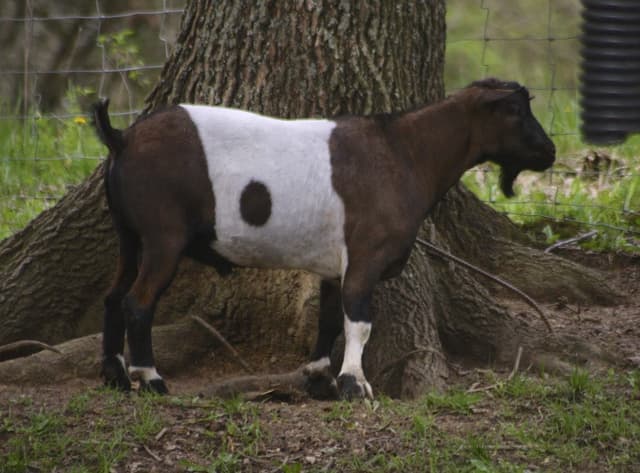

Registry name: Myotonic. Registered by Myotonic Goat Registry (MGR).
Is Fainting Goat (Myotonic) right for you?
About Fainting Goat (Myotonic)
This breed doesn’t really faint. What looks like one is a temporary, harmless stiffening of the muscles when it’s startled, a reflex called myotonia congenita, and it’s also why this breed rarely puts real pressure on a fence: the same stiffening limits how much it can climb or jump.
That same muscle behavior pays off on the table. The Livestock Conservancy cites studies finding a meat-to-bone ratio of about 4 to 1 in Myotonic goats, against roughly 3 to 1 in other breeds, attributed directly to the repeated isometric contractions building muscle throughout the body.
Bred mainly for meat, though plenty are kept as pets and exhibition animals for exactly the calm, docile temperament the breed is known for. Litters typically run 2 to 3 kids, and breeding is close to year-round rather than seasonal. The Livestock Conservancy lists the breed as recovering.
Good for a low-key meat or companion herd behind ordinary fencing. Not the breed for anyone bothered by the startle response itself, which is real and visible even if harmless.
How Fainting Goat (Myotonic) compares
Too few sourced figures for a group median: 1 of 9 meat breeds have one.
Does are cited at 100 lb, the same as the median of 100 lb across the 17 breeds in our list with a sourced doe weight.
Not enough sourced data to rank Fainting Goat (Myotonic) on weaning weight. Our sources didn’t publish one. 1 of 9 meat breeds in our list have a sourced figure for this.
Breeds like this one
Full record
Size
| Field | Value |
|---|---|
| Size class | Standard3 |
| Mature doe weight | 50–150 lb2 |
| Mature buck weight | 175 lb2 |
2 more fields not found in our sources
| Height at withers (doe) | Not found in our sources* |
| Height at withers (buck) | Not found in our sources* |
Appearance
| Field | Value |
|---|---|
| Coat type | Varies3 |
| Coat length | Varies3 |
| Colors | any color or pattern accepted3 |
| Patterns | any color or pattern accepted3 |
| Ears | Semi-pendulous3 |
| Horns | Horned or polled3 |
| Facial profile | Varies3 |
| Distinguishing features | Myotonia congenita: temporary muscle stiffening/collapse when startled, Prominent, protruding eye sockets with a distinct 'stop' at the eyes, Ears with a characteristic wave or ripple partway down the front edge3 |
Meat
Mature carcass: The Livestock Conservancy cites Virginia State University studies finding a meat-to-bone ratio of about 4:1 in Myotonic goats, versus about 3:1 in other breeds, attributed to the myotonic muscle-stiffening trait.1
Muscling: The repeated isometric-style muscle contractions of myotonia congenita are described by the Livestock Conservancy as building muscle throughout the body, giving heavier muscling than non-myotonic breeds of similar size.1
3 more fields not found in our sources
| Weaning weight | Not found in our sources* |
| Average daily gain | Not found in our sources* |
| Dressing percentage | Not found in our sources* |
Fiber
| Field | Value |
|---|---|
| Fiber type | Cashmere3 |
5 more fields not found in our sources
| Annual fleece yield | Not found in our sources* |
| Fiber diameter | Not found in our sources* |
| Staple length | Not found in our sources* |
| Shearings per year | Not found in our sources* |
| Down percentage | Not found in our sources* |
Breeding
| Field | Value |
|---|---|
| Litter size | 2–3 kids (typical)1 |
| Breeding season | Year-round breeder1 |
2 more fields not found in our sources
| Age at first breeding | Not found in our sources* |
| Weight at first breeding | Not found in our sources* |
Temperament and management
| Field | Value |
|---|---|
| Docility | Docile1 |
| Temperament tags | Docile, Calm, Alert1 |
| Handler experience level | Novice to intermediate1 |
| Fencing / escape difficulty | Low1 |
| Hardiness | High1 |
| Parasite resistance | High1 |
| Browse clearing suitability | Moderate1 |
Fencing: Because myotonia limits climbing and jumping, standard woven-wire or similar fencing tends to contain this breed more reliably than it does more athletic breeds.1
3 more fields not found in our sources
| Heat tolerance | Not found in our sources* |
| Cold tolerance | Not found in our sources* |
Housing: Not found in our sources*
Health and lifespan
| Field | Value |
|---|---|
| Common health issues | Myotonia congenita (temporary stiffening/collapse when startled)1 |
| Genetic conditions | Myotonia congenita1 |
Availability
| Field | Value |
|---|---|
| Conservation status | Recovering (The Livestock Conservancy, 2026)1 |
2 more fields not found in our sources
| Availability in the US | Not found in our sources* |
| Population estimate | Not found in our sources* |
About goats generally
The facts below are stated by extension and veterinary sources for goats as a species, not for this breed specifically, shown separately from the breed's own cited record above.
| Fencing / escape difficulty | High4‡ |
| Hardiness | High4‡ |
| Heat tolerance | High5‡ |
| Cold tolerance | Low6‡ |
| Browse clearing suitability | High4‡ |
Housing: Goats generally don't need elaborate housing -- a simple three-sided structure that blocks wind and rain is enough, at roughly 15 square feet of bedded space per animal. The real hazard is cold, damp drafts rather than fresh air itself: sustained drafty, wet-cold conditions can quickly bring on pneumonia and scours in young kids more than in adult stock.7‡
Fencing: Goats are notorious escape artists, so fencing built for cattle or sheep usually isn't enough. A multi-strand, electrified high-tensile fence with hot wires worked into the first, third and top strands is the standard effective approach; plain woven wire works too, but needs an extra interior electric strand to stop goats climbing on it or catching their heads and horns in the mesh.4‡
See our guides on how many goats to keep and how much space each one needs.
‡ Facts marked with a double dagger are about goats generally, not specifically this breed. See "About goats generally" above.
Sources (7)
- Myotonic or Tennessee Fainting Goat - The Livestock Conservancy · peer-reviewed / government / conservation body, retrieved 2026-09-05
- Heritage Goat Breed Comparison Chart - The Livestock Conservancy · peer-reviewed / government / conservation body, retrieved 2026-09-05
- Breed Description - Myotonic Goat Registry · breed registry / association, retrieved 2026-09-05
- Meat Goat Production | Penn State Extension · university extension, retrieved 2026-09-05
- Nutritional Requirements of Goats | Merck Veterinary Manual · peer-reviewed / government / conservation body, retrieved 2026-09-05
- Shelter, Fencing and Predator Control Needs on Pasture | Langston Ag Research · university extension, retrieved 2026-09-05
- Goat Housing and Facilities | Penn State Extension (Meat Goat Production and Management Home Study Course) · university extension, retrieved 2026-09-05
Want WhichGoat to keep showing up in your Google results?