Kalahari Red
Kalahari Reds have no US registry of their own, so breeders dual-register them under two other associations.

No registry found in our sources.
Is Kalahari Red right for you?
About Kalahari Red
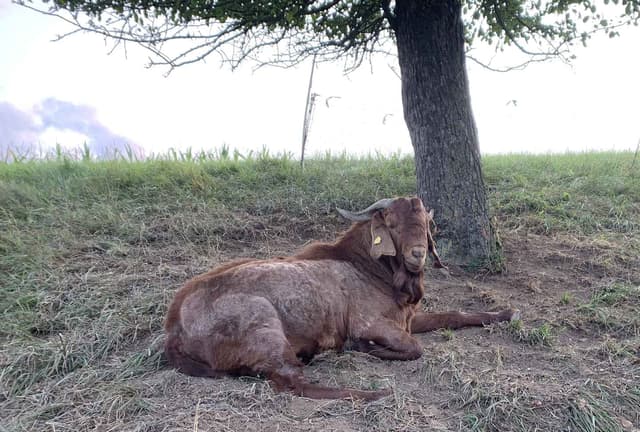
Kalahari Reds share their foundation stock with the Boer, developed from the same South African indigenous goats from around 1991, and carry a red coat as their clearest visual signature, with a frame and carcass size comparable to the Boer’s.
Mature bucks average around 253 lb, does around 165 lb, and bucks run consistently larger than does across every measured trait. It has a reputation as a “minimum care, maximum profit” animal, adapted to arid, semi-arid conditions, with skin pigmented enough to let it forage through the heat of the day.
Stateside, the breed has no herdbook of its own. Buyers work through ABGA or US-SABGBA registrations instead, and stock remains genuinely hard to find.
How Kalahari Red compares
Too few sourced figures for a group median: 1 of 9 meat breeds have one.
Does are cited at 165 lb, above the median of 100 lb across the 17 breeds in our list with a sourced doe weight.
Ranked 1st of 1 meat breeds on weaning weight. 8 more meat breeds are in our list without a sourced figure for this.
Breeds like this one
Full record
Size
| Field | Value |
|---|---|
| Size class | Large3 |
| Mature doe weight | 165 lb (75 kg) (typical)2 |
| Mature buck weight | 253 lb (115 kg) (typical)2 |
| Height at withers (doe) | 26.2 in (67 cm) (typical)2 |
| Height at withers (buck) | 29.1 in (74 cm) (typical)2 |
Appearance
| Field | Value |
|---|---|
| Colors | red4† |
| Distinguishing features | Bucks consistently larger than does across all measured morphometric traits, Frame and carcass size comparable to the Boer goat2 |
5 more fields not found in our sources
| Coat type | Not found in our sources* |
| Coat length | Not found in our sources* |
| Patterns | Not found in our sources* |
| Ears | Not found in our sources* |
| Horns | Not found in our sources* |
Meat
| Field | Value |
|---|---|
| Weaning weight | 20 lb (9 kg) (typical)3 |
| Average daily gain | 0.19 lb/day (84 g/day) (typical)3 |
Mature carcass: Peer-reviewed literature describes Kalahari Red as developed mainly for meat production, with a 'minimum care/maximum profit' reputation for adaptation to arid and semi-arid conditions.3
2 more fields not found in our sources
| Dressing percentage | Not found in our sources* |
Muscling: Not found in our sources*
Breeding
| Field | Value |
|---|---|
| Breeding season | Year-round breeder2 |
| Age at first breeding | 6 months or more3 |
2 more fields not found in our sources
| Litter size | Not found in our sources* |
| Weight at first breeding | Not found in our sources* |
Temperament and management
| Field | Value |
|---|---|
| Hardiness | High3 |
| Heat tolerance | High4† |
8 more fields not found in our sources
| Docility | Not found in our sources* |
| Temperament tags | Not found in our sources* |
| Handler experience level | Not found in our sources* |
| Cold tolerance | Not found in our sources* |
| Parasite resistance | Not found in our sources* |
| Browse clearing suitability | Not found in our sources* |
Housing: Not found in our sources*
Fencing: Not found in our sources*
Health and lifespan
| Field | Value |
|---|---|
| Lifespan | 8–15 years2 |
1 more field not found in our sources
| Common health issues | Not found in our sources* |
Availability
| Field | Value |
|---|---|
| Availability in the US | Rare1 |
| Registered kid price | Not applicable, No dedicated registry issues a 'registered' Kalahari Red kid in the US; animals are dual-registered as Boer-type stock. |
2 more fields not found in our sources
| Conservation status | Not found in our sources* |
| Population estimate | Not found in our sources* |
About goats generally
The facts below are stated by extension and veterinary sources for goats as a species, not for this breed specifically, shown separately from the breed's own cited record above.
| Fencing / escape difficulty | High5‡ |
| Hardiness | High5‡ |
| Heat tolerance | High6‡ |
| Cold tolerance | Low7‡ |
| Browse clearing suitability | High5‡ |
Housing: Goats generally don't need elaborate housing -- a simple three-sided structure that blocks wind and rain is enough, at roughly 15 square feet of bedded space per animal. The real hazard is cold, damp drafts rather than fresh air itself: sustained drafty, wet-cold conditions can quickly bring on pneumonia and scours in young kids more than in adult stock.8‡
Fencing: Goats are notorious escape artists, so fencing built for cattle or sheep usually isn't enough. A multi-strand, electrified high-tensile fence with hot wires worked into the first, third and top strands is the standard effective approach; plain woven wire works too, but needs an extra interior electric strand to stop goats climbing on it or catching their heads and horns in the mesh.5‡
See our guides on how many goats to keep and how much space each one needs.
† Descriptions marked with a dagger come from Oklahoma State University's breed pages, an educational encyclopedia rather than the breed's own registry or a university extension service. We use it for descriptions only, never for a number.
‡ Facts marked with a double dagger are about goats generally, not specifically this breed. See "About goats generally" above.
Sources (8)
- SA Boer Goat Association / SA Boerbok Telersvereniging · breed registry / association, retrieved 2026-09-05
- Principal Component Analysis of morphometric traits and body indices in South African Kalahari Red goats (South African Journal of Animal Science) · peer-reviewed / government / conservation body, retrieved 2026-09-05
- Comparative study of growth patterns of Kalahari Red goats and West African dwarf goats (Omotosho et al. 2020) · peer-reviewed / government / conservation body, retrieved 2026-09-05
- Kalahari Red Goats | Oklahoma State University · Oklahoma State breed pages (lower confidence), retrieved 2026-09-05
- Meat Goat Production | Penn State Extension · university extension, retrieved 2026-09-05
- Nutritional Requirements of Goats | Merck Veterinary Manual · peer-reviewed / government / conservation body, retrieved 2026-09-05
- Shelter, Fencing and Predator Control Needs on Pasture | Langston Ag Research · university extension, retrieved 2026-09-05
- Goat Housing and Facilities | Penn State Extension (Meat Goat Production and Management Home Study Course) · university extension, retrieved 2026-09-05
Want WhichGoat to keep showing up in your Google results?