Nigerian Dwarf
A small goat with a surprisingly serious milking habit.
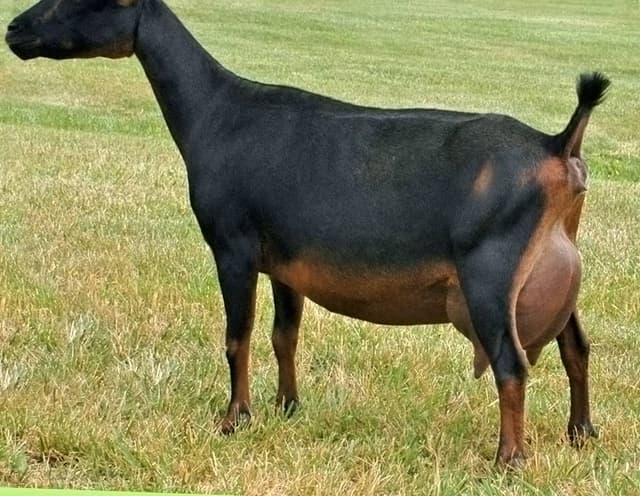

Registered by American Dairy Goat Association (ADGA), American Goat Society (AGS), Nigerian Dwarf Goat Association (NDGA).
Is Nigerian Dwarf right for you?
How much milk does a Nigerian Dwarf produce?
Penn State's summary of 20193 milk-recording data reports an average lactation yield of 795 lb3, with a recorded range of 220–2,110 lb3. These are lactation totals from recorded animals, not daily output or a promise for an individual doe.
The same source reports butterfat of 6.4%3 and protein of 4.4%3. Compare milk composition alongside volume when choosing a dairy breed. Our record has no sourced lactation length, so we do not divide the total by an assumed number of days to produce a daily estimate.
How big do Nigerian Dwarf goats get?
The height ranges recorded from the ADGA standard are 17–22.5 in1 for does and 17–23.5 in1 for bucks, measured at the withers. The NDGA brochure gives doe weight as 50 lb (typical)2. Breed-standard dimensions and typical weights describe different things; neither predicts every animal's size.
A small body does not settle the question of suitable housing. Check space, companionship and fencing requirements against your setup using our general goat guides.
How does a Nigerian Dwarf compare with a Pygmy?
Nigerian Dwarf's recorded primary purpose is Dairy1; Pygmy's is Show7. Our side-by-side comparison brings together their sourced size, conformation, milk and temperament records so you can compare more than their miniature stature.
About Nigerian Dwarf
Nigerian Dwarves pack a lot of milk into a small frame: butterfat runs around 6.4 percent, the richest of any breed here, from a goat that fits a suburban backyard. It’s also ADGA’s only recognized miniature dairy breed, and the single most-registered goat in the association’s books, with 28,097 registrations in 2024 alone.
The breed is friendly and gregarious, and hardy enough that owners of other livestock often find it blends into a mixed herd without needing purpose-built quarters of its own. It does need fencing sturdy enough to actually contain it, nothing elaborate, just adequate for an animal this small, and kids’ horns grow slowly enough that disbudding usually waits until around day 14 rather than the usual first week.
It shares its size class with the Pygmy, and the two are worth telling apart before buying: this is a dairy breed bred for milk, while the Pygmy is a show breed bred for a heavier, cobbier body. Not the goat to choose if milk isn’t actually the point.
How Nigerian Dwarf compares
This breed's cited milk yield is 795 lb, below the median of 2,237 lb for the 9 dairy breeds with a sourced figure.
Does are cited at 50 lb, below the median of 100 lb across the 17 breeds in our list with a sourced doe weight.
Ranked 9th of 9 dairy breeds on milk yield. 10 more dairy breeds are in our list without a sourced figure for this.
Often confused with, and breeds like this one
Full record
Size
| Field | Value |
|---|---|
| Size class | Miniature1 |
| Mature doe weight | 50 lb (typical)2 |
| Mature buck weight | 75 lb (typical)2 |
| Height at withers (doe) | 17–22.5 in1 |
| Height at withers (buck) | 17–23.5 in1 |
Appearance
| Field | Value |
|---|---|
| Coat type | Straight4 |
| Coat length | Short1 |
| Colors | any color or pattern accepted4 |
| Patterns | any color or pattern accepted4 |
| Ears | Erect4 |
| Facial profile | Varies1 |
| Blue eyes | Occurs in the breed4 |
| Distinguishing features | Only miniature dairy breed registered by ADGA, Occasional blue eyes, High-butterfat milk for its size1 |
1 more field not found in our sources
| Horns | Not found in our sources* |
Dairy
| Field | Value |
|---|---|
| Average lactation yield | 795 lb3 |
| Lactation yield range | 220–2,110 lb3 |
| Butterfat | 6.4%3 |
| Protein | 4.4%3 |
2 more fields not found in our sources
| Lactation length | Not found in our sources* |
| Milking temperament | Not found in our sources* |
Fiber
| Field | Value |
|---|---|
| Fiber type | None1 |
| Annual fleece yield | Not applicable, Not a fiber breed. |
| Fiber diameter | Not applicable, Not a fiber breed. |
| Staple length | Not applicable, Not a fiber breed. |
| Shearings per year | Not applicable, Not a fiber breed. |
| Down percentage | Not applicable, Not a fiber breed. |
Breeding
| Field | Value |
|---|---|
| Breeding season | Year-round breeder5 |
3 more fields not found in our sources
| Litter size | Not found in our sources* |
| Age at first breeding | Not found in our sources* |
| Weight at first breeding | Not found in our sources* |
Temperament and management
| Field | Value |
|---|---|
| Docility | Docile4 |
| Temperament tags | Friendly, Gregarious, Hardy-tempered, Curious4 |
| Hardiness | High4 |
Housing: Owners of other types of livestock often find their Nigerian Dwarves blend in well with a mixed herd and don't need separate, purpose-built quarters.8
Fencing: Nigerian Dwarves need fencing sturdy enough to contain them given their small size, though nothing purpose-built beyond that.8
5 more fields not found in our sources
| Handler experience level | Not found in our sources* |
| Heat tolerance | Not found in our sources* |
| Cold tolerance | Not found in our sources* |
| Parasite resistance | Not found in our sources* |
| Browse clearing suitability | Not found in our sources* |
Health and lifespan
Health note: Nigerian Dwarf kids tend to grow their horns more slowly than most breeds, so disbudding is usually done later -- around day 14 -- rather than the day 3-7 window used for most kids, to reduce pain and lower the chance of scur (partial horn regrowth).9
1 more field not found in our sources
| Common health issues | Not found in our sources* |
About goats generally
The facts below are stated by extension and veterinary sources for goats as a species, not for this breed specifically, shown separately from the breed's own cited record above.
| Fencing / escape difficulty | High12‡ |
| Hardiness | High12‡ |
| Heat tolerance | High13‡ |
| Cold tolerance | Low14‡ |
| Browse clearing suitability | High12‡ |
Housing: Goats generally don't need elaborate housing -- a simple three-sided structure that blocks wind and rain is enough, at roughly 15 square feet of bedded space per animal. The real hazard is cold, damp drafts rather than fresh air itself: sustained drafty, wet-cold conditions can quickly bring on pneumonia and scours in young kids more than in adult stock.15‡
Fencing: Goats are notorious escape artists, so fencing built for cattle or sheep usually isn't enough. A multi-strand, electrified high-tensile fence with hot wires worked into the first, third and top strands is the standard effective approach; plain woven wire works too, but needs an extra interior electric strand to stop goats climbing on it or catching their heads and horns in the mesh.12‡
See our guides on how many goats to keep and how much space each one needs.
† Descriptions marked with a dagger come from Oklahoma State University's breed pages, an educational encyclopedia rather than the breed's own registry or a university extension service. We use it for descriptions only, never for a number.
‡ Facts marked with a double dagger are about goats generally, not specifically this breed. See "About goats generally" above.
Sources (15)
- ADGA Breed Standards · breed registry / association, retrieved 2026-09-05
- NDGA downloadable breed brochure · breed registry / association, retrieved 2026-09-05
- Penn State Extension, Dairy Goat Production (Table 2, 2019 DHIR data) · university extension, retrieved 2026-09-05 (as of 2019)
- AGS Breed Standards · breed registry / association, retrieved 2026-09-05
- TMGR Miniature Dairy Goat Breed Standards (Mini Oberhasli page, describing Nigerian Dwarf foundation traits) · breed registry / association, retrieved 2026-09-05
- ADGA 2024 Annual Report · breed registry / association, retrieved 2026-09-05
- About - National Pygmy Goats Association · breed registry / association, retrieved 2026-09-05
- Temperament | Nigerian Dwarf Goat Association · breed registry / association, retrieved 2026-09-05
- Breeding and Parturition of Goats | Merck Veterinary Manual · peer-reviewed / government / conservation body, retrieved 2026-09-05
- Conservation Priority List - The Livestock Conservancy · peer-reviewed / government / conservation body, retrieved 2026-09-05 (as of 2026)
- Nigerian Dwarf Goats | Oklahoma State University · Oklahoma State breed pages (lower confidence), retrieved 2026-09-05
- Meat Goat Production | Penn State Extension · university extension, retrieved 2026-09-05
- Nutritional Requirements of Goats | Merck Veterinary Manual · peer-reviewed / government / conservation body, retrieved 2026-09-05
- Shelter, Fencing and Predator Control Needs on Pasture | Langston Ag Research · university extension, retrieved 2026-09-05
- Goat Housing and Facilities | Penn State Extension (Meat Goat Production and Management Home Study Course) · university extension, retrieved 2026-09-05
Want WhichGoat to keep showing up in your Google results?