Angora
Angoras are shorn twice a year for mohair, and weeks of cold vulnerability follow every shearing.
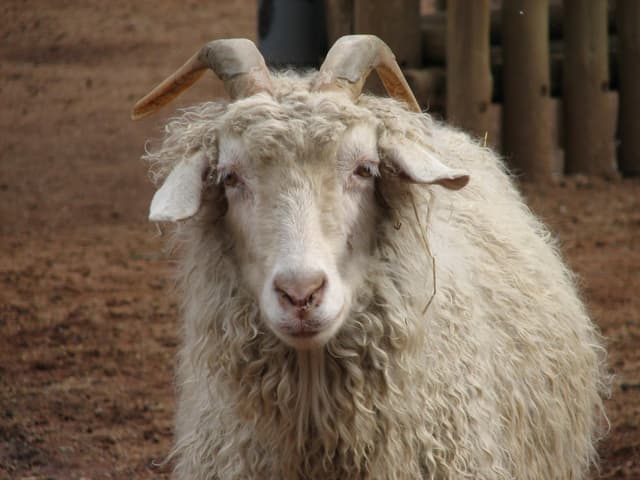

Registered by American Angora Goat Breeders' Association (AAGBA).
Is Angora right for you?
What does keeping Angora goats involve?
Plan for two shearings a year, with timing suited to your climate and available shelter. Arrange an experienced shearer before buying goats. UMass advises that animals should be dry for shearing; repeated passes over the same area create short second cuts that reduce fleece quality.6
Shelter is especially important after shearing. The American Angora Goat Breeders Association warns: Sheared twice a year, Angoras can freeze to death in cold, damp weather for up to six weeks afterward unless they're given shed shelter and adequate nutrition.7 Before choosing Angoras, check that you can protect the whole group during bad weather.
How much usable mohair will an Angora produce?
Our recorded annual fleece range is 12–35 lb2, spanning does and bucks in the University of Nebraska-Lincoln source. It is a fleece-weight range, not a prediction of finished fiber from an individual animal.
Raw fleece needs preparation. The British Angora Goat Society advises removing heavily stained or seed-contaminated material, large plant debris and short second cuts, then drying fleeces thoroughly before packing. These steps mean harvested weight and usable fiber are different measures.8
A heavier fleece is not automatically a finer one. The British breed standard treats fineness, length and density as important qualities and notes that selecting for fleece weight can also increase fiber diameter.9
Angora, Cashmere or Pygora?
Angoras produce Mohair3. Cashmere is the fine down separated from coarser guard hair; its breed standard distinguishes raw fleece weight from total down weight. Compare like-for-like processed fiber before using fleece weights to choose between them.10
Pygoras descend from Angora and Pygmy goats and have three recognized fleece types. Types A and B are usually shorn twice yearly; Type C can be brushed, plucked or shorn. The Pygora Breeders Association recommends dehairing all three types, so check the individual goat’s fleece and processing needs.11
Who are Angora goats suited to?
Our assessment: consider Angoras when mohair is your main reason for keeping goats and you can provide regular shearing, weather protection and time for fleece preparation. They are a weaker match if you want a pet or occasional vegetation control without committing to that fiber-care routine.
Use the documented requirements above to assess your setup. Breed choice alone does not establish how an individual animal will behave or whether selling its fleece will cover your costs.
About Angora
Angoras are a fiber breed raised for mohair. Choosing one means planning for the fleece as well as the goat: regular shearing, protection after shearing and preparation of the harvested fiber.
The answers above explain those requirements and compare Angoras with Cashmere and Pygora goats. Use the full record below to check the sourced measurements and their context.
How Angora compares
Too few sourced figures for a group median: 3 of 5 fiber breeds have one.
Does are cited at 90 lb, below the median of 100 lb across the 17 breeds in our list with a sourced doe weight.
Ranked 1st of 3 fiber breeds on fleece yield. 2 more fiber breeds are in our list without a sourced figure for this.
Breeds like this one
Full record
Size
| Field | Value |
|---|---|
| Size class | Standard2 |
| Mature doe weight | 80–100 lb2 |
| Mature buck weight | 90–120 lb2 |
2 more fields not found in our sources
| Height at withers (doe) | Not found in our sources* |
| Height at withers (buck) | Not found in our sources* |
Appearance
| Field | Value |
|---|---|
| Coat type | Mohair fleece3 |
| Coat length | Long3 |
| Colors | white3 |
| Patterns | Not applicable, AAGBA's standard is a solid-white requirement; no accepted patterns exist. |
| Horns | Horned2 |
| Distinguishing features | Long, lustrous ringlet-forming mohair fleece, Both sexes horned, bucks with pronounced spiraled horns, Sheared twice yearly rather than once3 |
1 more field not found in our sources
| Ears | Not found in our sources* |
Fiber
| Field | Value |
|---|---|
| Fiber type | Mohair3 |
| Annual fleece yield | 12–35 lb2 |
| Fiber diameter | 20–40 micron5 |
| Staple length | 4–6 in12 |
| Shearings per year | 22 |
| Down percentage | Not applicable, Mohair is a single-coat fleece; down percentage is a cashmere/cashgora-specific measure that does not apply. |
Breeding
| Field | Value |
|---|---|
| Litter size | 1–2 kids (typical)2 |
| Kidding rate | 120–140%2 |
| Breeding season | Seasonal breeder5 |
| Age at first breeding · sources disagree | 12–13 months (typical)2 One source reports 18–30 months (Puberty and Estrus in Goats | Merck Veterinary Manual, record). |
| Weight at first breeding · sources disagree | 55 lb or more5 One source reports 60 lb or more (Puberty and Estrus in Goats | Merck Veterinary Manual, record). |
Temperament and management
| Field | Value |
|---|---|
| Hardiness | Low4† |
| Cold tolerance | Moderate2 |
| Parasite resistance | Low2 |
| Browse clearing suitability | Moderate4† |
Housing: Sheared twice a year, Angoras can freeze to death in cold, damp weather for up to six weeks afterward unless they're given shed shelter and adequate nutrition.7
5 more fields not found in our sources
| Docility | Not found in our sources* |
| Temperament tags | Not found in our sources* |
| Handler experience level | Not found in our sources* |
| Heat tolerance | Not found in our sources* |
Fencing: Not found in our sources*
Health and lifespan
| Field | Value |
|---|---|
| Common health issues | High susceptibility to internal parasites (Haemonchus contortus / stomach worms), Coccidiosis2 |
Availability
| Field | Value |
|---|---|
| Conservation status | Not listed (The Livestock Conservancy, 2026)13 |
| Population estimate | 3,000 head14 |
1 more field not found in our sources
| Availability in the US | Not found in our sources* |
History and registries
| Field | Value |
|---|---|
| Origin country | Turkey4† |
About goats generally
The facts below are stated by extension and veterinary sources for goats as a species, not for this breed specifically, shown separately from the breed's own cited record above.
| Fencing / escape difficulty | High15‡ |
| Hardiness | High15‡ |
| Heat tolerance | High16‡ |
| Cold tolerance | Low17‡ |
| Browse clearing suitability | High15‡ |
Housing: Goats generally don't need elaborate housing -- a simple three-sided structure that blocks wind and rain is enough, at roughly 15 square feet of bedded space per animal. The real hazard is cold, damp drafts rather than fresh air itself: sustained drafty, wet-cold conditions can quickly bring on pneumonia and scours in young kids more than in adult stock.18‡
Fencing: Goats are notorious escape artists, so fencing built for cattle or sheep usually isn't enough. A multi-strand, electrified high-tensile fence with hot wires worked into the first, third and top strands is the standard effective approach; plain woven wire works too, but needs an extra interior electric strand to stop goats climbing on it or catching their heads and horns in the mesh.15‡
See our guides on how many goats to keep and how much space each one needs.
† Descriptions marked with a dagger come from Oklahoma State University's breed pages, an educational encyclopedia rather than the breed's own registry or a university extension service. We use it for descriptions only, never for a number.
‡ Facts marked with a double dagger are about goats generally, not specifically this breed. See "About goats generally" above.
Sources (18)
- Home | American Angora Goat Breeder's Association · breed registry / association, retrieved 2026-09-05
- RP375 Angora Goats in the Midwest, University of Nebraska-Lincoln Extension · university extension, retrieved 2026-09-05
- The American Angora Goat Breeders Association Breed Standard For Angora Goats · breed registry / association, retrieved 2026-09-05
- Angora Goats | Oklahoma State University · Oklahoma State breed pages (lower confidence), retrieved 2026-09-05
- Angora Goats | UC Small Farms Network · university extension, retrieved 2026-09-05
- Angora Goat Shearing, UMass Amherst · university extension, retrieved 2026-09-13
- About Us | American Angora Goat Breeder's Association · breed registry / association, retrieved 2026-09-05
- Shearing, Sorting and Packing Your Mohair, British Angora Goat Society · breed registry / association, retrieved 2026-09-13
- The Breed Standard, British Angora Goat Society · breed registry / association, retrieved 2026-09-13
- North American Cashmere Goat Breed Standard, Cashmere Goat Association · breed registry / association, retrieved 2026-09-13
- Pygora Fiber, Pygora Breeders Association · breed registry / association, retrieved 2026-09-13
- Angora Goat and Mohair Production, Texas A&M AgriLife Research and Extension Center at San Angelo · university extension, retrieved 2026-09-05
- Conservation Priority List - The Livestock Conservancy · peer-reviewed / government / conservation body, retrieved 2026-09-05 (as of 2026)
- RP375 Angora Goats in the Midwest, University of Nebraska-Lincoln Extension · university extension, retrieved 2026-09-05 (as of 1990)
- Meat Goat Production | Penn State Extension · university extension, retrieved 2026-09-05
- Nutritional Requirements of Goats | Merck Veterinary Manual · peer-reviewed / government / conservation body, retrieved 2026-09-05
- Shelter, Fencing and Predator Control Needs on Pasture | Langston Ag Research · university extension, retrieved 2026-09-05
- Goat Housing and Facilities | Penn State Extension (Meat Goat Production and Management Home Study Course) · university extension, retrieved 2026-09-05
Want WhichGoat to keep showing up in your Google results?