Cashmere
Cashmere isn't really a breed, just a fiber qualification any goat can earn.
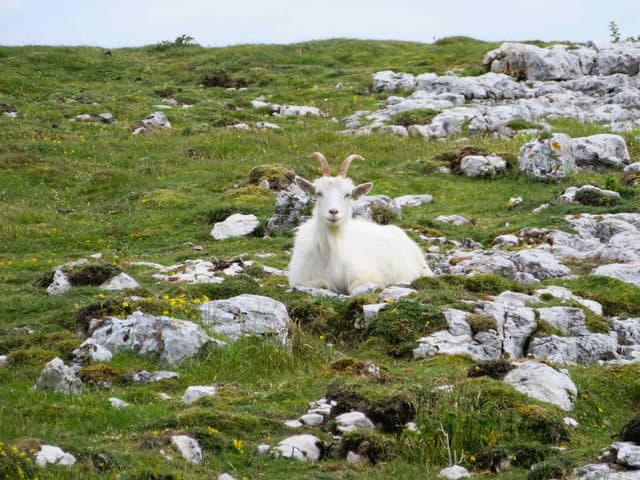
,_Llandudno,_Wales_10.jpg)
Registered by Cashmere Goat Association (CGA).
Is Cashmere right for you?
About Cashmere
Cashmere isn’t really a breed. It’s a fiber type: any goat whose down grows fine enough, 19 microns or finer, the international benchmark for true cashmere, qualifies, whatever breed it started out as. That makes this one of the least uniform entries here by design.
What does hold across registered animals is a bent toward easy management: the breed is easy to raise, takes only minimal care, and isn’t prone to jumping, so standard woven-wire sheep fencing is usually enough to contain it. Minimal shelter suffices too, since the dual coat does most of the insulating work itself.
Breeding runs seasonal, with kids typically arriving from late February through early May. A doe needs to reach at least 75 lb before breeding.
A low-maintenance choice for someone specifically after fiber, not conformation, from a base animal that could be almost any breed underneath the down. Not the breed to choose if a predictable body type matters as much as the fleece.
How Cashmere compares
Too few sourced figures for a group median: 3 of 5 fiber breeds have one.
Not enough sourced data to compare this breed's doe weight to the all-breed median. 17 of 28 breeds in our list have a sourced doe weight.
Not enough sourced data to rank Cashmere on fleece yield. Our sources didn’t publish one. 3 of 5 fiber breeds in our list have a sourced figure for this.
Breeds like this one
Full record
Size
| Field | Value |
|---|---|
| Size class | Standard2 |
| Mature doe weight | 75 lb or more2 |
3 more fields not found in our sources
| Mature buck weight | Not found in our sources* |
| Height at withers (doe) | Not found in our sources* |
| Height at withers (buck) | Not found in our sources* |
Appearance
| Field | Value |
|---|---|
| Coat type | Double-coated with down5 |
| Colors | any color4 |
| Patterns | contrast points (face/stockings/belly)4 |
| Distinguishing features | Qualifies on fiber traits (fineness, style, length, uniformity) rather than a fixed body type, Fine down undercoat shed seasonally beneath coarser guard hair1 |
3 more fields not found in our sources
| Coat length | Not found in our sources* |
| Ears | Not found in our sources* |
| Horns | Not found in our sources* |
Meat
Mature carcass: UC ANR notes that thicker-bodied, meatier cashmere goats bring in additional income when sold for meat or culled, alongside their fiber value.2
4 more fields not found in our sources
| Weaning weight | Not found in our sources* |
| Average daily gain | Not found in our sources* |
| Dressing percentage | Not found in our sources* |
Muscling: Not found in our sources*
Fiber
| Field | Value |
|---|---|
| Fiber type | Cashmere1 |
| Fiber diameter | up to 19 micron1 |
| Staple length | 1.3 in or more1 |
| Down percentage | 30% or more2 |
2 more fields not found in our sources
| Annual fleece yield | Not found in our sources* |
| Shearings per year | Not found in our sources* |
Breeding
| Field | Value |
|---|---|
| Breeding season | Seasonal breeder2 |
| Weight at first breeding | 55 lb or more2 |
2 more fields not found in our sources
| Litter size | Not found in our sources* |
| Age at first breeding | Not found in our sources* |
Temperament and management
| Field | Value |
|---|---|
| Fencing / escape difficulty | Low3† |
| Hardiness | High4 |
Housing: Shearing removes the insulating cashmere undercoat and raises the goats' energy needs, especially in colder conditions, so sheared animals need more shelter and feed support than their full winter coat alone would suggest.6
Fencing: Standard woven-wire fencing with roughly six-inch openings will generally contain Cashmere goats; adding a single electrified strand about eight inches off the ground helps stop kids from getting their heads caught in the mesh.4
7 more fields not found in our sources
| Docility | Not found in our sources* |
| Temperament tags | Not found in our sources* |
| Handler experience level | Not found in our sources* |
| Heat tolerance | Not found in our sources* |
| Cold tolerance | Not found in our sources* |
| Parasite resistance | Not found in our sources* |
| Browse clearing suitability | Not found in our sources* |
History and registries
| Field | Value |
|---|---|
| Origin country | China3† |
About goats generally
The facts below are stated by extension and veterinary sources for goats as a species, not for this breed specifically, shown separately from the breed's own cited record above.
| Fencing / escape difficulty | High7‡ |
| Hardiness | High7‡ |
| Heat tolerance | High6‡ |
| Cold tolerance | Low8‡ |
| Browse clearing suitability | High7‡ |
Housing: Goats generally don't need elaborate housing -- a simple three-sided structure that blocks wind and rain is enough, at roughly 15 square feet of bedded space per animal. The real hazard is cold, damp drafts rather than fresh air itself: sustained drafty, wet-cold conditions can quickly bring on pneumonia and scours in young kids more than in adult stock.9‡
Fencing: Goats are notorious escape artists, so fencing built for cattle or sheep usually isn't enough. A multi-strand, electrified high-tensile fence with hot wires worked into the first, third and top strands is the standard effective approach; plain woven wire works too, but needs an extra interior electric strand to stop goats climbing on it or catching their heads and horns in the mesh.7‡
See our guides on how many goats to keep and how much space each one needs.
† Descriptions marked with a dagger come from Oklahoma State University's breed pages, an educational encyclopedia rather than the breed's own registry or a university extension service. We use it for descriptions only, never for a number.
‡ Facts marked with a double dagger are about goats generally, not specifically this breed. See "About goats generally" above.
Sources (9)
- North American Cashmere Goat Breed Standard (CGA/Hoofprints newsletter copy) · breed registry / association, retrieved 2026-09-05
- Cashmere Goats | UC Small Farms Network · university extension, retrieved 2026-09-05
- Cashmere Goats | Oklahoma State University · Oklahoma State breed pages (lower confidence), retrieved 2026-09-05
- Cashmere Goat FAQ - Cashmere Goat Association · breed registry / association, retrieved 2026-09-05
- Cashmere Goat Association · breed registry / association, retrieved 2026-09-05
- Nutritional Requirements of Goats | Merck Veterinary Manual · peer-reviewed / government / conservation body, retrieved 2026-09-05
- Meat Goat Production | Penn State Extension · university extension, retrieved 2026-09-05
- Shelter, Fencing and Predator Control Needs on Pasture | Langston Ag Research · university extension, retrieved 2026-09-05
- Goat Housing and Facilities | Penn State Extension (Meat Goat Production and Management Home Study Course) · university extension, retrieved 2026-09-05
Want WhichGoat to keep showing up in your Google results?