Golden Guernsey
A decade after the US recognized the breed, Golden Guernseys are still hard to find here.
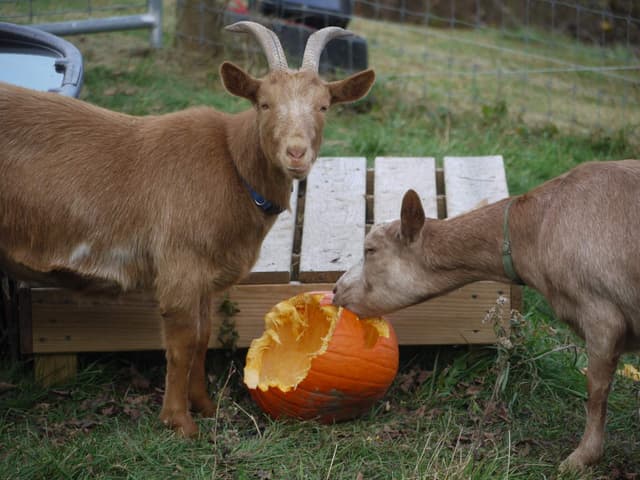

Registered by British Goat Society (BGS), Golden Guernsey Goat Society / Royal Golden Guernsey Goat Society (GGGS/RGGGS), Guernsey Goat Breeders of America (GGBoA), American Dairy Goat Association (ADGA).
Is Golden Guernsey right for you?
About Golden Guernsey
Miriam Milbourne is the reason Golden Guernseys still exist as a named breed at all. She revived the line on Guernsey itself from the 1920s through the 1950s, kept her herd through the German occupation of the island, and saw the first exports reach mainland Britain in 1965.
The signature is the coat: a gold body color, ranging from pale flaxen to deep bronze, on a frame smaller than the other standard dairy breeds, with ears carried low in a distinctive “bonnet” position rather than the more common erect Swiss-type carriage. Butterfat runs about 3.7 percent, and the temperament is generally quiet and docile.
This page covers both the British Golden Guernsey and the American Guernsey bred from it: ADGA opened a US herdbook, registered simply as “Guernsey,” back in October 2015, after the Guernsey Goat Breeders of America petitioned for recognition starting in 2010. A decade in, it remains genuinely rare on this side of the Atlantic: just 289 animals were registered in 2024, and the UK’s Rare Breeds Trust lists the parent breed as at risk.
A distinctive, gentle dairy goat for someone prepared to search and wait for stock, not for anyone who needs an animal this year.
How Golden Guernsey compares
Not enough sourced data to compare this breed on milk yield. Our sources didn’t publish one.
Not enough sourced data to compare this breed's doe weight to the all-breed median. 17 of 28 breeds in our list have a sourced doe weight.
Not enough sourced data to rank Golden Guernsey on milk yield. Our sources didn’t publish one. 9 of 19 dairy breeds in our list have a sourced figure for this.
Breeds like this one
Full record
Size
| Field | Value |
|---|---|
| Size class | Standard4 |
| Mature doe weight | 120 lb or more2 |
| Mature buck weight | 150 lb or more2 |
| Height at withers (doe) | 26 in or more2 |
| Height at withers (buck) | 28 in or more2 |
Appearance
| Field | Value |
|---|---|
| Coat type | Varies2 |
| Coat length | Varies2 |
| Colors | gold (flaxen cream to russet/bronze)2 |
| Patterns | roaning, white patches, white face, star/blaze2 |
| Ears | Erect2 |
| Facial profile | Varies2 |
| Distinguishing features | Gold body color and skin, ranging pale flaxen to deep bronze, Ears carried in a distinctive low 'bonnet' position, never pendulous, Smaller than the other standard-sized dairy breeds2 |
1 more field not found in our sources
| Horns | Not found in our sources* |
Dairy
| Field | Value |
|---|---|
| Butterfat | 3.7%3 |
| Protein | 2.8%3 |
4 more fields not found in our sources
| Average lactation yield | Not found in our sources* |
| Lactation yield range | Not found in our sources* |
| Lactation length | Not found in our sources* |
| Milking temperament | Not found in our sources* |
Fiber
| Field | Value |
|---|---|
| Fiber type | None2 |
| Annual fleece yield | Not applicable, Not a fiber breed. |
| Fiber diameter | Not applicable, Not a fiber breed. |
| Staple length | Not applicable, Not a fiber breed. |
| Shearings per year | Not applicable, Not a fiber breed. |
| Down percentage | Not applicable, Not a fiber breed. |
Temperament and management
| Field | Value |
|---|---|
| Docility | Docile1 |
| Temperament tags | Docile, Quiet1 |
8 more fields not found in our sources
| Handler experience level | Not found in our sources* |
| Hardiness | Not found in our sources* |
| Heat tolerance | Not found in our sources* |
| Cold tolerance | Not found in our sources* |
| Parasite resistance | Not found in our sources* |
| Browse clearing suitability | Not found in our sources* |
Housing: Not found in our sources*
Fencing: Not found in our sources*
Also registered as British Guernsey (BGS, United Kingdom). A graded-up derivative recognized as its own Herd Book section in 1996: slightly larger and heavier-boned than the closed-bred Golden Guernsey, produced by repeated use of Golden Guernsey males on Saanen-cross females.
About goats generally
The facts below are stated by extension and veterinary sources for goats as a species, not for this breed specifically, shown separately from the breed's own cited record above.
| Fencing / escape difficulty | High7‡ |
| Hardiness | High7‡ |
| Heat tolerance | High8‡ |
| Cold tolerance | Low9‡ |
| Browse clearing suitability | High7‡ |
Housing: Goats generally don't need elaborate housing -- a simple three-sided structure that blocks wind and rain is enough, at roughly 15 square feet of bedded space per animal. The real hazard is cold, damp drafts rather than fresh air itself: sustained drafty, wet-cold conditions can quickly bring on pneumonia and scours in young kids more than in adult stock.10‡
Fencing: Goats are notorious escape artists, so fencing built for cattle or sheep usually isn't enough. A multi-strand, electrified high-tensile fence with hot wires worked into the first, third and top strands is the standard effective approach; plain woven wire works too, but needs an extra interior electric strand to stop goats climbing on it or catching their heads and horns in the mesh.7‡
See our guides on how many goats to keep and how much space each one needs.
‡ Facts marked with a double dagger are about goats generally, not specifically this breed. See "About goats generally" above.
Sources (10)
- Breed Standards - British Goat Society · breed registry / association, retrieved 2026-09-05
- ADGA Breed Standards (Guernsey) · breed registry / association, retrieved 2026-09-05
- ADGA breed description document (GGBoA breed recognition proposal, quoting BGS recording data; archived, live page now members-only) · breed registry / association, retrieved 2026-09-05
- About Guernsey Goats - GGBoA · breed registry / association, retrieved 2026-09-05
- Royal Golden Guernsey - RBST Watchlist · peer-reviewed / government / conservation body, retrieved 2026-09-05 (as of 2025)
- ADGA 2024 Annual Report · breed registry / association, retrieved 2026-09-05 (as of 2024)
- Meat Goat Production | Penn State Extension · university extension, retrieved 2026-09-05
- Nutritional Requirements of Goats | Merck Veterinary Manual · peer-reviewed / government / conservation body, retrieved 2026-09-05
- Shelter, Fencing and Predator Control Needs on Pasture | Langston Ag Research · university extension, retrieved 2026-09-05
- Goat Housing and Facilities | Penn State Extension (Meat Goat Production and Management Home Study Course) · university extension, retrieved 2026-09-05
Want WhichGoat to keep showing up in your Google results?