LaMancha
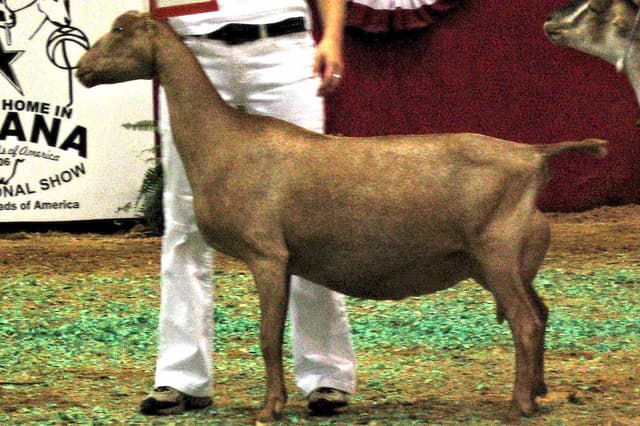
LaManchas are bred to have almost no external ear at all, a prized trait, not a fault.

Registered by American Dairy Goat Association (ADGA), American Goat Society (AGS).
Is LaMancha right for you?
About LaMancha
LaManchas are instantly recognizable for one thing: they don’t really have external ears, just a small “gopher” nub or a slightly longer “elf” ear, a defining trait rather than a defect, on a breed developed in Oregon from Spanish stock by Eula Frey.
Production backs up the look. Does average around 2,298 lb of milk a season at about 3.7 percent butterfat, among the richer milk of the standard dairy breeds here, and the breed is widely known for calm, even manners on the milk stand specifically, not just in general temperament.
That calm carries through the rest of the animal. LaManchas have a quiet, personable disposition, and the body itself often reads shorter and blockier than the more rangy Swiss-type breeds. It produces well across a genuinely wide range of climates and conditions, which suits a first dairy setup as much as an established one.
It is still a standard-size dairy goat, built for milking, not for a small backyard companion role. Anyone drawn to the look because the ears seem low-maintenance should know the udder and the routine behind it are not.
How LaMancha compares
This breed's cited milk yield is 2,298 lb, above the median of 2,237 lb for the 9 dairy breeds with a sourced figure.
Not enough sourced data to compare this breed's doe weight to the all-breed median. 17 of 28 breeds in our list have a sourced doe weight.
Ranked 4th of 9 dairy breeds on milk yield. 10 more dairy breeds are in our list without a sourced figure for this.
Often confused with, and breeds like this one
Full record
Size
| Field | Value |
|---|---|
| Size class | Standard1 |
| Mature doe weight | 130 lb or more1 |
| Mature buck weight · sources disagree | 160 lb or more1 One source reports 155 lb or more (AGS Breed Standards, breed standard). |
| Height at withers (doe) | 28 in or more1 |
| Height at withers (buck) | 30 in or more1 |
Appearance
| Field | Value |
|---|---|
| Coat type | Smooth1 |
| Coat length | Short1 |
| Colors | any color or pattern accepted3 |
| Patterns | any color or pattern accepted3 |
| Ears | Elf, Gopher3 |
| Facial profile | Straight1 |
| Distinguishing features | Vestigial 'gopher' or small 'elf' ears in place of normal external ears, Body often shorter and blockier than other dairy breeds, Widely respected docile, even temperament3 |
1 more field not found in our sources
| Horns | Not found in our sources* |
Dairy
| Field | Value |
|---|---|
| Average lactation yield | 2,298 lb2 |
| Lactation yield range | 830–4,120 lb2 |
| Butterfat | 3.7%2 |
| Protein | 3.2%2 |
| Milking temperament | Docile3 |
1 more field not found in our sources
| Lactation length | Not found in our sources* |
Fiber
| Field | Value |
|---|---|
| Fiber type | None1 |
| Annual fleece yield | Not applicable, Not a fiber breed. |
| Fiber diameter | Not applicable, Not a fiber breed. |
| Staple length | Not applicable, Not a fiber breed. |
| Shearings per year | Not applicable, Not a fiber breed. |
| Down percentage | Not applicable, Not a fiber breed. |
Breeding
| Field | Value |
|---|---|
| Weight at first breeding | 70 lb4 |
3 more fields not found in our sources
| Litter size | Not found in our sources* |
| Breeding season | Not found in our sources* |
| Age at first breeding | Not found in our sources* |
Temperament and management
| Field | Value |
|---|---|
| Docility | Docile3 |
| Temperament tags | Docile3 |
| Hardiness | High1 |
| Heat tolerance | High1 |
| Cold tolerance | High1 |
5 more fields not found in our sources
| Handler experience level | Not found in our sources* |
| Parasite resistance | Not found in our sources* |
| Browse clearing suitability | Not found in our sources* |
Housing: Not found in our sources*
Fencing: Not found in our sources*
About goats generally
The facts below are stated by extension and veterinary sources for goats as a species, not for this breed specifically, shown separately from the breed's own cited record above.
| Fencing / escape difficulty | High8‡ |
| Hardiness | High8‡ |
| Heat tolerance | High9‡ |
| Cold tolerance | Low10‡ |
| Browse clearing suitability | High8‡ |
Housing: Goats generally don't need elaborate housing -- a simple three-sided structure that blocks wind and rain is enough, at roughly 15 square feet of bedded space per animal. The real hazard is cold, damp drafts rather than fresh air itself: sustained drafty, wet-cold conditions can quickly bring on pneumonia and scours in young kids more than in adult stock.11‡
Fencing: Goats are notorious escape artists, so fencing built for cattle or sheep usually isn't enough. A multi-strand, electrified high-tensile fence with hot wires worked into the first, third and top strands is the standard effective approach; plain woven wire works too, but needs an extra interior electric strand to stop goats climbing on it or catching their heads and horns in the mesh.8‡
See our guides on how many goats to keep and how much space each one needs.
† Descriptions marked with a dagger come from Oklahoma State University's breed pages, an educational encyclopedia rather than the breed's own registry or a university extension service. We use it for descriptions only, never for a number.
‡ Facts marked with a double dagger are about goats generally, not specifically this breed. See "About goats generally" above.
Sources (11)
- ADGA Breed Standards · breed registry / association, retrieved 2026-09-05
- Penn State Extension, Dairy Goat Production (Table 2, 2019 DHIR data) · university extension, retrieved 2026-09-05 (as of 2019)
- AGS Breed Standards · breed registry / association, retrieved 2026-09-05
- Puberty and Estrus in Goats | Merck Veterinary Manual · peer-reviewed / government / conservation body, retrieved 2026-09-05
- ADGA 2024 Annual Report · breed registry / association, retrieved 2026-09-05
- Conservation Priority List - The Livestock Conservancy · peer-reviewed / government / conservation body, retrieved 2026-09-05 (as of 2026)
- Lamancha Goats | Oklahoma State University · Oklahoma State breed pages (lower confidence), retrieved 2026-09-05
- Meat Goat Production | Penn State Extension · university extension, retrieved 2026-09-05
- Nutritional Requirements of Goats | Merck Veterinary Manual · peer-reviewed / government / conservation body, retrieved 2026-09-05
- Shelter, Fencing and Predator Control Needs on Pasture | Langston Ag Research · university extension, retrieved 2026-09-05
- Goat Housing and Facilities | Penn State Extension (Meat Goat Production and Management Home Study Course) · university extension, retrieved 2026-09-05
Want WhichGoat to keep showing up in your Google results?