Toggenburg
Toggenburg is a standard-sized dairy breed from Switzerland.

Registered by American Dairy Goat Association (ADGA), American Goat Society (AGS).
Is Toggenburg right for you?
About Toggenburg
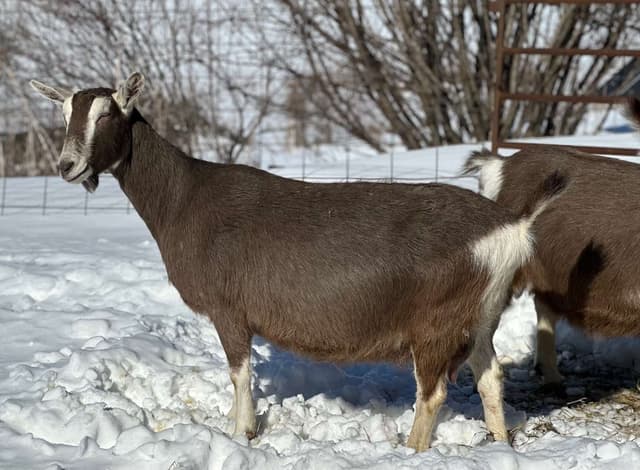
Toggenburgs are a calm, steady milker rather than a flashy one, producing about 2,237 lb a season at 3.1 percent butterfat with a nature AGS credits as genuinely calm alongside that productivity. The breed traces back to Switzerland’s Toggenburg Valley and was among the first purebred dairy goats imported and registered in the US, carrying a solid fawn-to-chocolate coat with distinctive white and cream facial and leg markings.
It thrives in cooler conditions, which tracks with its Swiss valley origins, so a hot climate is worth weighing before committing.
US registrations sit around 1,500 a year, common enough to source without much difficulty, though well behind the newer, more heavily promoted dairy breeds. No conservation flag attaches to it here.
A calm, long-established dairy goat for a cooler climate and a steady milking routine. Not the breed for someone chasing maximum yield, or for hot, humid ground.
How Toggenburg compares
This breed's cited milk yield is 2,237 lb, the same as the median of 2,237 lb for the 9 dairy breeds with a sourced figure.
Not enough sourced data to compare this breed's doe weight to the all-breed median. 17 of 28 breeds in our list have a sourced doe weight.
Ranked 5th of 9 dairy breeds on milk yield. 10 more dairy breeds are in our list without a sourced figure for this.
Often confused with, and breeds like this one
Full record
Size
| Field | Value |
|---|---|
| Size class | Standard1 |
| Mature doe weight | 120 lb or more1 |
| Mature buck weight | 150 lb or more1 |
| Height at withers (doe) | 26 in or more1 |
| Height at withers (buck) | 28 in or more1 |
Appearance
| Field | Value |
|---|---|
| Coat type | Smooth1 |
| Coat length | Varies3 |
| Colors | light fawn to dark chocolate, black (does only)1 |
| Patterns | white/cream Toggenburg markings1 |
| Ears | Erect1 |
| Facial profile | Varies1 |
| Distinguishing features | Solid fawn-to-chocolate coat with characteristic white/cream Toggenburg markings, Among the first purebred dairy goats imported and registered in the US, Oldest known dairy goat breed1 |
1 more field not found in our sources
| Horns | Not found in our sources* |
Dairy
| Field | Value |
|---|---|
| Average lactation yield | 2,237 lb2 |
| Lactation yield range | 1,090–3,840 lb2 |
| Butterfat | 3.1%2 |
| Protein | 2.9%2 |
| Milking temperament | Docile3 |
1 more field not found in our sources
| Lactation length | Not found in our sources* |
Fiber
| Field | Value |
|---|---|
| Fiber type | None1 |
| Annual fleece yield | Not applicable, Not a fiber breed. |
| Fiber diameter | Not applicable, Not a fiber breed. |
| Staple length | Not applicable, Not a fiber breed. |
| Shearings per year | Not applicable, Not a fiber breed. |
| Down percentage | Not applicable, Not a fiber breed. |
Temperament and management
| Field | Value |
|---|---|
| Docility | Docile3 |
| Temperament tags | Calm3 |
| Heat tolerance | Low6† |
| Cold tolerance | High4† |
6 more fields not found in our sources
| Handler experience level | Not found in our sources* |
| Hardiness | Not found in our sources* |
| Parasite resistance | Not found in our sources* |
| Browse clearing suitability | Not found in our sources* |
Housing: Not found in our sources*
Fencing: Not found in our sources*
Availability
| Field | Value |
|---|---|
| Availability in the US | Common5 |
| Conservation status | Not listed (The Livestock Conservancy, 2026)7 |
| Population estimate | 1,576 annual registrations5 |
History and registries
| Field | Value |
|---|---|
| Origin country | Switzerland6† |
About goats generally
The facts below are stated by extension and veterinary sources for goats as a species, not for this breed specifically, shown separately from the breed's own cited record above.
| Fencing / escape difficulty | High8‡ |
| Hardiness | High8‡ |
| Heat tolerance | High9‡ |
| Cold tolerance | Low10‡ |
| Browse clearing suitability | High8‡ |
Housing: Goats generally don't need elaborate housing -- a simple three-sided structure that blocks wind and rain is enough, at roughly 15 square feet of bedded space per animal. The real hazard is cold, damp drafts rather than fresh air itself: sustained drafty, wet-cold conditions can quickly bring on pneumonia and scours in young kids more than in adult stock.11‡
Fencing: Goats are notorious escape artists, so fencing built for cattle or sheep usually isn't enough. A multi-strand, electrified high-tensile fence with hot wires worked into the first, third and top strands is the standard effective approach; plain woven wire works too, but needs an extra interior electric strand to stop goats climbing on it or catching their heads and horns in the mesh.8‡
See our guides on how many goats to keep and how much space each one needs.
† Descriptions marked with a dagger come from Oklahoma State University's breed pages, an educational encyclopedia rather than the breed's own registry or a university extension service. We use it for descriptions only, never for a number.
‡ Facts marked with a double dagger are about goats generally, not specifically this breed. See "About goats generally" above.
Sources (11)
- ADGA Breed Standards · breed registry / association, retrieved 2026-09-05
- Penn State Extension, Dairy Goat Production (Table 2, 2019 DHIR data) · university extension, retrieved 2026-09-05 (as of 2019)
- AGS Breed Standards · breed registry / association, retrieved 2026-09-05
- Toggenburg Goats - Oklahoma State University - Breeds of Livestock · Oklahoma State breed pages (lower confidence), retrieved 2026-09-07
- ADGA 2024 Annual Report · breed registry / association, retrieved 2026-09-05
- Toggenburg Goats | Oklahoma State University · Oklahoma State breed pages (lower confidence), retrieved 2026-09-05
- Conservation Priority List - The Livestock Conservancy · peer-reviewed / government / conservation body, retrieved 2026-09-05 (as of 2026)
- Meat Goat Production | Penn State Extension · university extension, retrieved 2026-09-05
- Nutritional Requirements of Goats | Merck Veterinary Manual · peer-reviewed / government / conservation body, retrieved 2026-09-05
- Shelter, Fencing and Predator Control Needs on Pasture | Langston Ag Research · university extension, retrieved 2026-09-05
- Goat Housing and Facilities | Penn State Extension (Meat Goat Production and Management Home Study Course) · university extension, retrieved 2026-09-05
Want WhichGoat to keep showing up in your Google results?